
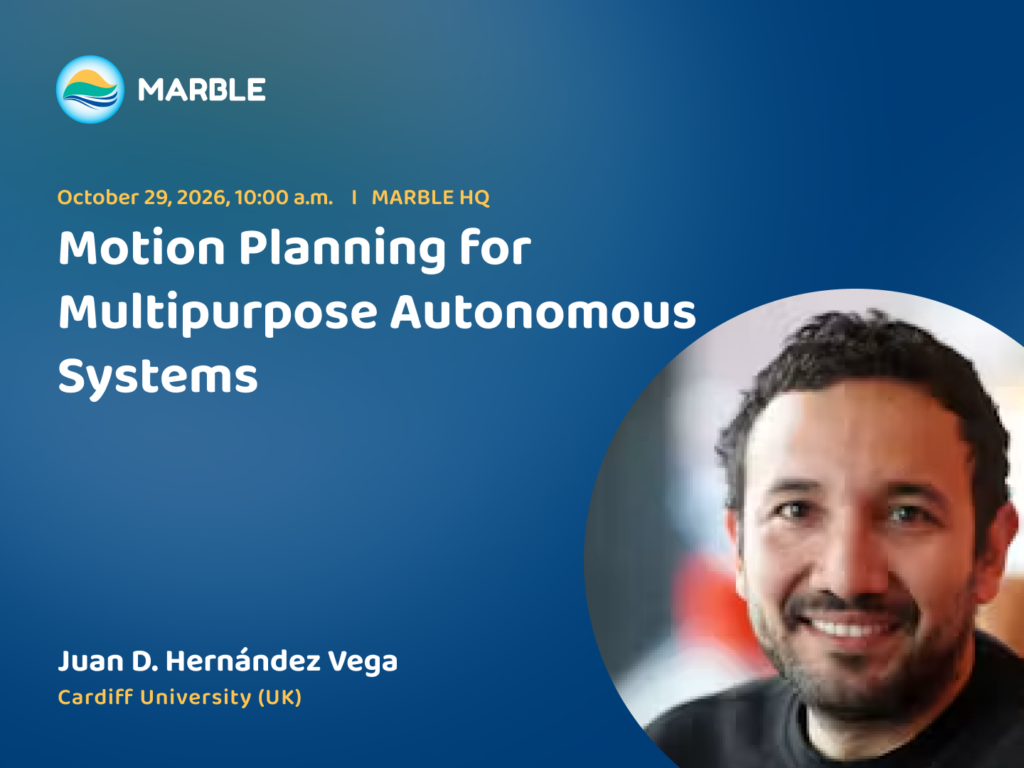
MARBLE, UNIZG-FER Laboratory of Underwater Systems and Technologies (LABUST), and IEEE OES University of Zagreb Student Branch Chapter organized a lecture “Motion Planning for Multipurpose Autonomous Systems” that will be held by Juan D. Hernández Vega, PhD, from Cardiff University (UK).
The lecture will take place on Thursday, October 29th, 2026, at 10:00 a.m. at MARBLE HQ (Froudeova 13).
Summary of the lecture
Once limited to highly controlled industrial environments only, today robots are continuously evolving towards becoming autonomous entities, capable of operating in changing and unstructured settings. This evolution is only possible due to multi-disciplinary efforts, which endow autonomous systems with the required capabilities to deal with such changing and uncertain conditions. One of these disciplines, commonly known as motion planning, consists in computational techniques that calculate collision-free and feasible motions of autonomous systems. In this talk, we will discuss how motion planning is being used to improve the decision-making capabilities of different types of autonomous systems such as autonomous underwater vehicles (AUVs), autonomous/automated cars, robotic manipulators, and service robots.
Short CV
Juan D. Hernández received the BSc degree in electronic engineering from the Pontifical Xavierian University (Cali, Colombia) in 2009, the MSc degree in robotics and automation from the Technical University of Madrid (Spain) in 2012, and the PhD degree in technology (robotics) from the University of Girona (Spain) in 2017. He worked as a Robotics Research Engineer at the Netherlands Organisation for Applied Scientific Research (TNO) in 2017-2018. He was a Postdoctoral Research Associate at Rice University (Houston, TX, USA) in 2018-2019. He was a Senior Engineer for simulation of autonomous systems at Apple Inc. (Sunnyvale, CA, USA) in 2019-2020. In December 2020, he joined Cardiff University, where he is now a Senior Lecturer in the School of Computational and Mathematical Sciences, leads the Human-centred and Computational Robotics research group, and co-leads the Cardiff University Computational Robotics (CUCR) research team. His research activity is focused on hybrid motion planning approaches that combine classical model-based methods with machine learning techniques, as well as the use of multimodal interfaces that enhance human-robot interaction and collaboration. Dr Hernández is a Senior member of the IEEE and its Robotics and Automation Society.