
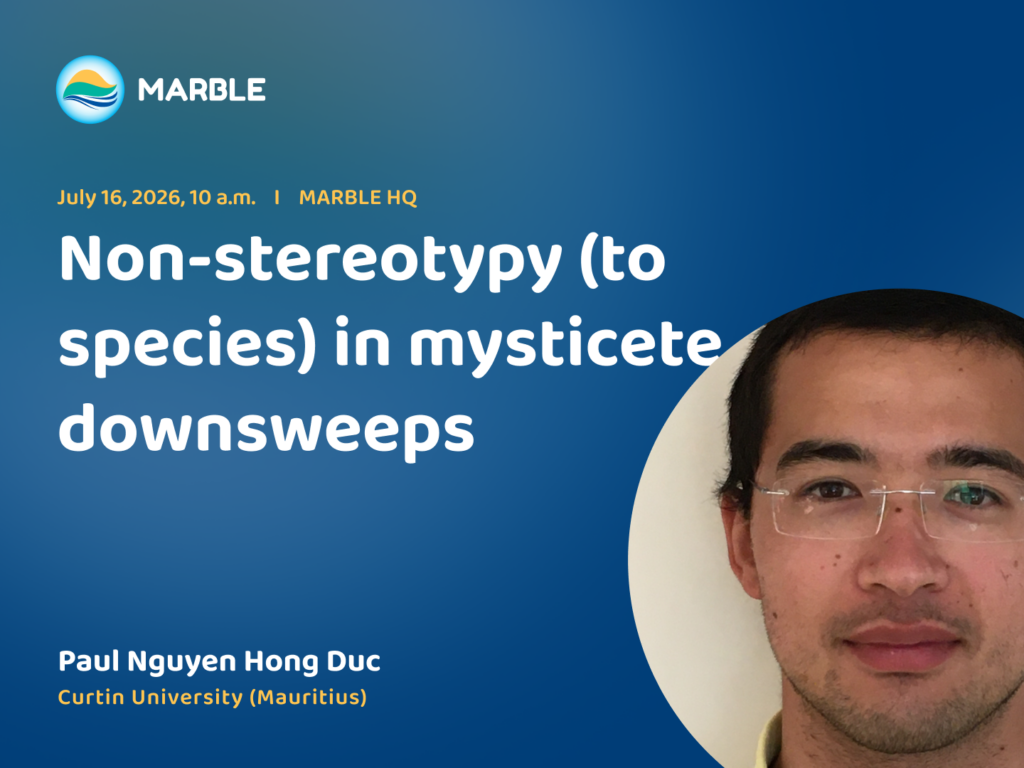
MARBLE, UNIZG-FER Laboratory of Underwater Systems and Technologies (LABUST), and IEEE OES University of Zagreb Student Branch Chapter are organizing a lecture “Non-stereotypy (to species) in mysticete downsweeps” held by Paul Nguyen Hong Duc from Curtin University, Mauritius, as part of the MARBLE project.
The lecture will place on Thursday, July 16th, 2026, at the MARBLE HQ (meeting room Tramontana on the ground floor), as part of the MARBLE project.
Summary of the lecture:
The Australian Exclusive Economic Zone (EEZ) seasonally hosts ten mysticete whale species, providing habitat for critical life functions from feeding to breeding. Because all of these species produce downsweeping calls, distinguishing them acoustically is difficult and can compromise passive acoustic monitoring. To optimize a detector for Eastern Indian Ocean pygmy blue whale (EIOPBW) downsweeps, we tested two approaches: a spectrogram correlator built from confirmed call templates, and a neural network trained on general blue whale D-calls combined with clustering algorithms. Bioacousticians manually validated the outputs. We found that downsweeps are highly variable, forming a graded continuum of acoustic features rather than discrete clusters. Comparative analysis revealed overlap between EIOPBW call variants and the downsweeps of other mysticete species, casting doubt on the reliability of assigning calls to a species based on spectrographic features alone. By contrast, the geographic and seasonal distribution of downsweeps provided more conclusive evidence for EIOPBW identity when matched against known migratory routes and timing. We acknowledge several limitations: the difficulty of automated detection, variability in environmental noise, and human bias in manual classification. To strengthen species identification, we recommend integrating soft labeling, advanced acoustic transforms, sound propagation corrections, and cross-referenced call databases. Until automated methods become more reliable, passive acoustic monitoring will continue to depend on a multidisciplinary approach that combines regional ecological knowledge with manual validation.