
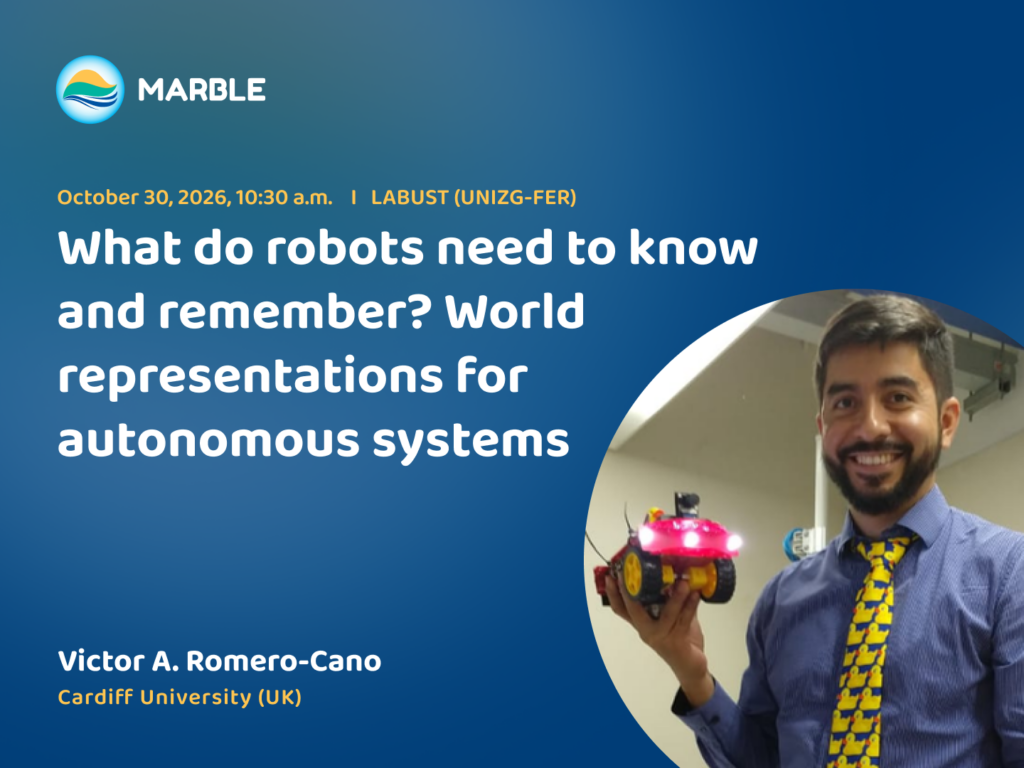
MARBLE, UNIZG-FER Laboratory of Underwater Systems and Technologies (LABUST), and IEEE OES University of Zagreb Student Branch Chapter organized a lecture “What do robots need to know and remember? World representations for autonomous systems” that will be held by Victor A. Romero-Cano, PhD, from Cardiff University (UK).
The lecture will take place on Friday, October 30th, 2026, at 10:30 a.m. at LABUST (UNIZG-FER, Miramarska cesta 20).
Summary of the lecture
For robots to act autonomously in the world, they must first understand it. But what does that understanding look like, how should it be structured, and how much of it should come from experience rather than current observations alone? This talk explores world representation from the perspective of autonomous systems operating in complex environments, asking not just what robots can perceive, but what they need to remember to act effectively, how that knowledge should be organised, and how it should be accumulated over time. A central theme is that effective autonomy requires layered world representations that integrate geometry, semantics, structure, and dynamics, combining learned priors drawn from past experience with what is sensed and estimated in the moment. We will discuss how these representations support downstream perception and decision-making for both mobile and manipulator robots and reflect on the design principles that make them tractable and useful for agents that must think, learn, and act in the physical world.
Short CV
Dr. Victor Romero Cano is a Senior Lecturer in the School of Computational and Mathematical Sciences at Cardiff University, where he is a member of the Human-Centred Computing Research Unit, co-leads the Cardiff University Computational Robotics (CUCR) research team, and manages the Human Centred Computing and Robotics (HCCR) Laboratory. His research focuses on robotics, embodied AI, machine learning, robot perception, and autonomous systems, with applications ranging from autonomous driving to human-centred robotics. He received his PhD from the University of Sydney, following an MSc from the University of São Paulo and a degree in Mechatronics Engineering from Universidad Autónoma de Occidente, Colombia. His career spans both academia and industry across Australia, France, Colombia, Croatia, and the United Kingdom, including positions at the Rio Tinto Centre for Mine Automation, Inria Grenoble, Toyota Motor Europe, Universidad Autónoma de Occidente, and Rimac Technology. Dr. Romero Cano is a Senior Member of IEEE and its IEEE Robotics and Automation Society. He also serves as an Associate Editor for IEEE Robotics and Automation Letters (RA-L).